

  Zakharova says West seeks Armenia’s minerals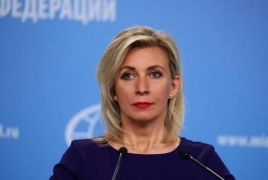 June 4, 2026 - 16:33 AMT PanARMENIAN.Net - Russian Foreign Ministry spokeswoman Maria Zakharova stated that the West is interested in Armenia’s rare mineral resources. She made the remarks during the St. Petersburg International Economic Forum. She added that the West and the United States are guided by a logic of “taking and plundering” in their approach to Armenia, TASS reports. Zakharova drew attention to differing views regarding relations between Russia and Armenia. “One can continue living in illusions, or one can look reality in the eye and see what is actually happening. The logic of taking, ‘plundering, appropriating, humiliating and destroying’ is still alive in the West, unfortunately, and it is being applied in the Caucasus as well,” she said. As an example, she cited the recent visit of U.S. Secretary of State Marco Rubio to Armenia. “After all, he did not conclude international treaties that are binding on both sides, because that would imply an equal partnership. Certain declarative documents were signed, but there is an obvious trend, as they themselves would say, toward resource-intensive sectors and rare minerals that are of great interest to the United States,” the Russian Foreign Ministry spokeswoman noted. According to her, while the United States is effectively assuming no obligations, it is simultaneously seeking to secure its interest in sectors that are important for future development, particularly in light of digitalization, high technologies, and artificial intelligence. “In other words, they seem to be taking on no responsibility, yet they have secured for themselves what is truly a necessary component of future development, considering digitalization, high technologies, and artificial intelligence,” Zakharova emphasized, describing such an approach as a form of “struggle.” She also recalled that documents similar to those signed in Yerevan during Rubio’s visit had been signed under the previous U.S. administration. “Documents similar to those now signed in Yerevan with Rubio were also signed during the previous American administration. I would like to ask: what among them has actually been implemented?” she stated. Zakharova observed that competition over resource-rich regions of the world has continued for decades and even centuries. “There is a struggle that has lasted for decades, centuries, over resource-rich regions of the world — a real struggle,” she said. According to her, Russia has long proposed, and continues to propose, a different approach. “We have proposed a different approach and have done so throughout a long historical process — not to fight for others’ resources, not to appropriate them, but to develop relations on the basis of mutual respect and mutually beneficial cooperation,” Zakharova stressed. In her view, this approach became a distinctive alternative that was consolidated in the 20th century after World War II. She explained that this involved the creation of the United Nations system of international law, the expansion of international legal mechanisms, the process of decolonization, the recognition of the sovereignty and independence of countries under pressure, the establishment of full-fledged relations with states that the West had often regarded as second-rate, and efforts to secure peace in those regions so that development could take place. According to Zakharova, countries possess different capabilities and levels of potential, yet they can develop without competing for the resources of others. “Russia has offered and continues to offer Armenia mutually beneficial and mutually respectful communication and the development of relations in all areas — energy, trade, and tourism,” she said. She stressed that this is not merely about declarations. “This is not simply a statement of intentions that remains on paper. It is not a public relations campaign where people arrive, sign documents, shake hands, then leave and forget,” the diplomat said. Zakharova also stated that Russia’s commitments have been fulfilled and continue to be fulfilled. “What is signed by our side has been implemented and continues to be implemented. And it is being done in the interests of the peoples of our countries,” she said. She urged observers not to view Armenian-Russian relations as processes that develop automatically. “This is not about passive processes, like ‘it rained’ or ‘thunder struck.’ It is about active work in international affairs and on global platforms to defend the principles that form the foundation of our civilization. Not barbarism, not Nazism and fascism, not the slave trade, not colonialism, and not wild imperialism based on pressure and exploitation, but relations founded on equality, mutual benefit, mutual respect, law, legality, and consideration of each other’s traditions and interests,” the Russian Foreign Ministry spokeswoman emphasized. During the meeting of the Supreme Eurasian Economic Council in Astana on May 29, the presidents of Russia, Kazakhstan, Belarus, and Kyrgyzstan adopted a statement regarding Armenia’s situation. Armenia was urged to hold a referendum as soon as possible on choosing between the Eurasian Economic Union and the European Union. In recent days, various Russian officials have also stated that if Armenia continues moving toward the European Union, it could lose access to Russian gas on preferential terms. In addition, Russia has imposed restrictions on imports of Armenian products. Imports of Jermuk mineral water, flowers, and certain alcoholic beverages from Armenia have been banned. Restrictions have also been introduced on several agricultural products, including tomatoes, cucumbers, and strawberries. Since June 2, Russia has restricted imports of cherries, apricots, peaches, plums, grapes, and other stone fruits from Armenia, as well as their transit to other Eurasian Economic Union member states. Since June 3, Russia has also restricted imports of eggplants, potatoes, and dried fruits originating from and exported by Armenia.   Top stories Top stories The foreign ministers of Armenia and Azerbaijan, Ararat Mirzoyan and Jeyhun Bayramov, have arrived in Washington. The CSTO budget for the current year requires adjustments due to the refusal of Yerevan to pay their share of contributions. Six total incidents have burned 19 old-growth trees. Friday night 8 trees were torched along the beautiful main entrance. The EU does not intend to conduct military exercises with Armenia, Lead Spokesperson for EU Foreign Affairs and Security Policy Peter Stano says.   Partner news |  Latest news Latest news Viva sees growing demand for cloud services Viva sees growing demand for cloud services  In recent years, medical institutions are starting to make use of Viva’s cloud servicesTurkey replacing term "Central Asia" with "Turkestan" in textbooks The Turkish Ministry of Education is replacing the term "Central Asia" with "Turkestan" in textbooks.Armenia assumes presidency of Mediterranean Network of Regulatory Authorities The Commission on Television and Radio of Armenia said it expects productive cooperation in various formats.Balance of attached cards in the Idram&IDBank app From now on, users will be able to view the online balances of cards issued by ArCa system banks and attached to the app. In recent years, medical institutions are starting to make use of Viva’s cloud servicesTurkey replacing term "Central Asia" with "Turkestan" in textbooks The Turkish Ministry of Education is replacing the term "Central Asia" with "Turkestan" in textbooks.Armenia assumes presidency of Mediterranean Network of Regulatory Authorities The Commission on Television and Radio of Armenia said it expects productive cooperation in various formats.Balance of attached cards in the Idram&IDBank app From now on, users will be able to view the online balances of cards issued by ArCa system banks and attached to the app. |