


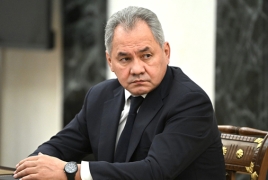


Russian Security Council Secretary Sergei Shoigu, commenting on U.S. intentions to build small modular reactors (SMRs) in Armenia, said the American side often presents attractive business proposals, but no such reactor has yet been built in the United States.
“Yes, there are several companies in the U.S. engaged in this field. Yes, they all have very appealing business proposals. However, as they say, there are nuances… To date, not a single small modular reactor has been built by the Americans, let alone commissioned or operated industrially. I emphasize — not a single one,” Shoigu said, according to RIA Novosti.
He also recalled that Armenia is located in a seismically active zone. According to him, if the SMR construction project in Armenia enters a practical phase, Russia and other regional states will have to take into account new nuclear safety risks.
“In essence, we must proceed from the understanding that American experiments in nuclear technologies would be carried out next to us, in a seismically hazardous area. Therefore, yes, this should be considered a threat. I would not like to draw parallels, but let me remind you that at Japan’s Fukushima-1 nuclear power plant, it was precisely American reactors that were damaged as a result of the earthquake, leading to large-scale radioactive contamination of the environment,” he added.
Shoigu also stressed that even an approximate price per megawatt-hour of electricity to be generated has not been publicly disclosed, although this indicator is of fundamental importance.
“If we are talking about NuScale Power’s 77-megawatt modules, then the high cost of electricity was the reason the project failed in Utah. Even at the preparatory stage, the cost increased by one and a half times, and the projected electricity price rose from $58 per megawatt-hour to $89, which led to the project’s cancellation in 2023,” he said.
In addition, Shoigu noted that the United States does not possess technologies for reprocessing spent nuclear fuel. According to him, if the project is implemented in Armenia, the spent fuel would be stored within the country.
Responding to a question about possible Russian proposals, Shoigu said Armenia’s top leadership is aware of Russia’s initiatives in the field of nuclear energy. He emphasized that Rosatom is a leader in the number of nuclear power plants built abroad, accounting for about 90 percent of the global market, and has unique experience in designing, constructing and operating small modular reactors.
“Without disclosing details, I will say that the conditions are extremely favorable, and the technologies are the most advanced, with reliability proven through many years of operation. I would hope that when our partners make the relevant decisions, sober calculation and the interests of the people will prevail, rather than a mindset in the spirit of ‘I’ll freeze my ears to spite my mother,’” Shoigu said.
On February 9, U.S. Vice President J.D. Vance announced following his visit to Armenia that, within the framework of a memorandum on cooperation in nuclear energy, the United States intends to supply Armenia with small modular reactors. He presented the estimated cost of the project at $9 billion — $5 billion for the construction of SMRs and $4 billion for fuel supply and long-term maintenance.