


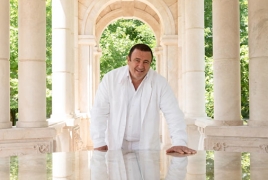


Gagik Tsarukyan, one of Armenia’s wealthiest and most widely discussed businessmen, is seeking to associate his name with a project that he says will place Armenia at the center of global attention, according to an article published by The Guardian.
“Behind the high walls of a sprawling estate on the outskirts of Yerevan, six tigers roam enclosed grounds, three lions pace inside their cages, and alligators rest in the afternoon heat. Deeper inside the property, other animals can also be seen.
In a hall with a gilded, hand-painted ceiling stand taxidermied animals of various species. According to the owner, he personally hunted all of them. Together, these details offer an insight into the tastes and interests of Gagik Tsarukyan,” the article says.
It notes that after receiving less than 4 percent of the vote in parliamentary elections, Tsarukyan is unlikely ever to lead Armenia. Nevertheless, one of the country’s richest and most controversial figures continues to seek a place in history.
To achieve that, he has chosen a symbolic undertaking: the world’s tallest statue of Jesus Christ, which is to be erected on a 2,500-meter mountain overlooking Yerevan.
“For some, it is a celebration of Armenia’s ancient Christian heritage; for others, it is a reflection of one oligarch’s outsized ambitions. In one of his rare interviews, conducted at his mansion in his native village of Arinj, Tsarukyan said: ‘This will become Armenia’s calling card. Christianity will become Armenia’s new brand,’” the article states.
According to Tsarukyan, the project is intended to reflect an international movement that combines religious faith, national ideology and conservatism. In his view, this trend is particularly visible in U.S. President Donald Trump’s MAGA movement and among right-wing forces in Europe.
“Trump is, of course, invited. We hope he comes,” Tsarukyan said, adding that an unofficial American delegation connected to the U.S. Embassy had already visited the construction site.
Once completed, the 101-meter statue will stand on Mount Hatis, around 25 kilometers east of Yerevan, making it visible from much of the capital. Tsarukyan noted with satisfaction that it will exceed the size of Brazil’s famous Christ statue and be slightly taller than New York’s Statue of Liberty.
The article notes that although most of Armenia’s neighboring countries today have Muslim majorities, Armenia is widely recognized as the first state in the world to officially adopt Christianity, traditionally dated to the year 301.
It also notes that the Armenian Apostolic Church has repeatedly opposed the project, arguing that its scale and style do not align with Armenian religious and architectural traditions. Church representatives have emphasized that Armenian Christianity has historically expressed itself through monasteries, churches and khachkars rather than through the giant-statue format common in some other countries. Environmental activists have also criticized the project, warning that construction could damage the natural environment of Mount Hatis.
Tsarukyan dismissed the concerns raised by clergy and activists, stressing that the monument is intended not only for believers but could attract a much broader audience. He claimed that up to 10 million tourists a year could eventually visit the site.
During The Guardian’s visit, the giant white figure of Christ towered above piles of stone, cranes and industrial buildings, giving the landscape an unusual appearance.
The article says election results showed that the Russia-friendly Prosperous Armenia Party failed to clear the 4 percent threshold required to enter parliament, although the party is challenging the outcome in court.
“This result continued the political decline of a figure who for nearly two decades was regarded as one of Armenia’s key power brokers. Tsarukyan built his position through close ties with former president Robert Kocharyan, expanding a business empire within a narrow circle of politically connected entrepreneurs.
His private zoo, marble mansions and collection of luxury cars made him one of the symbols of the post-Soviet economic boom years, when great fortunes were accumulated quickly and displayed with little restraint. That image made him a natural target for Prime Minister Nikol Pashinyan, who came to power after the 2018 Velvet Revolution promising to fight the oligarchic system,” the article says.
It notes that in a victory speech on June 7, Pashinyan pledged to imprison his political opponents, specifically naming Tsarukyan, Robert Kocharyan and businessman Samvel Karapetyan. The following day, investigators arrived at Tsarukyan’s estate to bring tax-related charges against him.
According to Tsarukyan, his team’s main concern at present is not political challenges but the technical task of transporting the statue to the mountain summit.
The article notes that the logistical challenges of the project are almost as ambitious as the idea itself. The original plan was to transport sections of the monument by helicopter, but a more conventional approach was later chosen: carrying the parts up the mountain by truck and assembling the structure on site.
It also notes that another biblical-themed project has already begun nearby: the construction of a giant Noah’s Ark. The structure will be 134 meters long, 24 meters wide and 18 meters high. A museum is planned on the first floor, a hotel on the second and a café on the third.
The article presents differing views on the statue.
It notes that Tsarukyan’s projects are seen by some as an effort to promote national heritage and tourism, while others regard them as excessively lavish and controversial initiatives.