

  Sargsyan rejects Pashinyan’s Karabakh blame game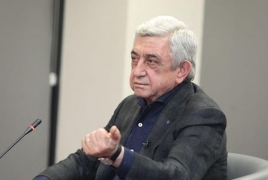 December 10, 2025 - 17:13 AMT PanARMENIAN.Net - Former president Serzh Sargsyan responded to the December 2 release of Karabakh negotiation documents, calling it a failed attempt by Pashinyan to shift responsibility. Sargsyan declared that the official commentary titled “What the Nagorno‑Karabakh negotiation package reveals,” issued when the Armenian government published documents related to the Karabakh peace process on December 2, 2025, is nothing but a simplistic and, moreover, futile attempt to place responsibility for the disastrous consequences of the authorities’ failed policies on others — policies pursued since May 2018 over the Nagorno‑Karabakh issue. A simple question arises: if, according to the current Armenian leadership, the negotiation process and the co‑chairs’ proposals allegedly favored only Baku, then why did the Azerbaijani side — at least between 2008 and 2018 — repeatedly reject all those proposals, criticize the co‑chairs, even call for disbanding the group? Unlike Armenia, Azerbaijan refused to adopt the five declarations issued by the co‑chairs (the presidents of Russia, the U.S., and France) on Nagorno‑Karabakh in meetings held in Lake Como, Moscow, Los Cabos, and Eniskilleen. Azerbaijan also rejected the OSCE (Organization for Security and Co‑operation in Europe) foreign ministers’ statements adopted between 2008–2017, as well as the declaration from the 2010 OSCE summit in Astana, or later backtracked from previously agreed decisions. Azerbaijan repeatedly declined the agreements reached at summits in Saint Petersburg (June 17, 2010), Astrakhan (October 27, 2010), Sochi (March 3, 2011), Kazan (June 24, 2011), Sochi again (January 23, 2012), Vienna (May 16, 2016), Saint Petersburg again (June 20, 2016), and Geneva (October 16, 2017). By consistently undermining the negotiation process, Azerbaijan on many occasions threatened to withdraw from it until 2018 — although it never took that step, reportedly because it feared a direct confrontation both with the international mediators (the three permanent members of the U.N. Security Council: Russia, the U.S., and France), and thereby with the entire international community. Meanwhile, Baku, repeatedly violating cease‑fires and torpedoing the talks, pushed Armenia to abandon negotiations so that Armenia would be blamed for the failure of peace efforts. But Azerbaijan has never succeeded in doing so. Moreover, the positions of Armenia and the OSCE Minsk Group co‑chairs often became nearly identical, a fact repeatedly declared publicly. By rejecting nearly all proposals and initiatives of the co‑chairs, or constantly backtracking on previously agreed terms, Azerbaijan opposed not only Armenia but the entire international community in its approach to resolving the conflict, the statement noted. Sargsyan pointed out that after the change of power in Armenia in spring 2018, it was obvious that the efforts and importance of preserving all the diplomatic work produced over years needed continuation, and that retreating could lead to unpredictable consequences. The Minsk Group co‑chairs shared that opinion. However, after May 2018, the new Armenian authorities declared their decision to restart negotiations “from their own point,” effectively abandoning the results of previous diplomatic efforts, yet they failed to explain even to the co‑chairs what exactly that “own point” was. Although Armenia’s stance had repeatedly been affirmed as aligned with the Minsk Group co‑chairs’ approaches, from that moment on, Yerevan turned in the eyes of the international community into the unconstructive party in the negotiations. And once the new ruling power, acting recklessly, began to cast doubt on whether the conflict could be resolved through negotiations, Baku obtained what it had long sought: a casus belli — a pretext for war — accusing Armenia of refusing talks. Could the war have been avoided? Probably yes, if Armenia had been ready to respond adequately, and if it had received support and understanding from allies and the international community, which would have taken decisive steps to immediately halt military actions. We witnessed such a scenario in April 2016, when, having failed in diplomacy, Azerbaijan launched aggressive actions against Karabakh, attempting to militarily impose its positions within the negotiation process, but those attempts failed. However, due to the obvious diplomatic, political, and military mistakes by Pashinyan and his team, in 2020, Armenia found itself in a very tragic situation, leading to catastrophic military defeat with thousands of casualties and loss of Artsakh (Nagorno‑Karabakh). The claims that during the negotiation process, Russia and the other co-chairs had allegedly offered Azerbaijan the return of the seven districts around Nagorno‑Karabakh under Armenian control, without providing guarantees on status, security, or other features, are not only untrue, but do not withstand any criticism. The co-chairs repeatedly clarified that, and the documents published by the current Armenian authorities on December 2 clearly prove it. Between December 2008 and June 24, 2011, Russia, Armenia, and Azerbaijan held negotiations under the auspices of the Minsk Group co‑chairs on agreeing on the Basic Principles. There were twelve summit meetings — bilateral (Armenia–Azerbaijan) and trilateral (Russia–Armenia–Azerbaijan) — and about thirty meetings of foreign ministers. Each time, Azerbaijan withdrew from previously agreed terms. The high point was the Kazan summit, where, contrary to the co‑chairs’ expectations, Azerbaijan effectively rejected the main agreed text, demanding more than ten changes. Even after Kazan, from 2011 to 2018, the co‑chairs continued efforts to find a path to settlement. The draft Basic Principles discussed at Kazan (the final working document submitted to the OSCE Secretariat, together with all other working documents negotiated before 2011) never became a subject of negotiations. It is no coincidence that the then Russian Foreign Minister repeatedly stated that “no documents exist except those deposited with the OSCE.” Between 2011 and 2018, all proposals developed were shared as “non‑papers.” In June 2011, the version discussed in Kazan was followed only in form, not in substance. The last variants of those “non‑papers” were formulated as three interrelated documents, forming a comprehensive foundation for a package settlement of the Nagorno‑Karabakh conflict. On January 18, 2018, the “non‑paper” presented in Krakow included only three points on one page — suggestions by the co‑chairs that could be included in a possible joint declaration by Armenia and Azerbaijan. Baku rejected even that proposal. Only in June 2019, a year after Pashinyan came to power, was the first official document signed by the co‑chairs handed over to the parties. It contained proposals similar to those submitted in April 2019 without co‑chairs’ signatures. What provisions had been developed with the co‑chairs since 2008 regarding Karabakh settlement: Interim status. Until a final status decision, Nagorno‑Karabakh would receive interim status with full definition of its legislative, executive and local governance bodies, courts, self‑defense forces, and rule of law; accreditation to the OSCE; eligibility for membership in international organizations (where interim status would not hinder membership); international investments; donor aid; and access to foreign markets. Co‑chairs emphasized that this meant “status quo plus,” not the abolition of the existing Karabakh status. Final legal status. The final legal status of Nagorno‑Karabakh was to be determined by a referendum allowing the population to freely express its will, as co‑chairs always insisted, despite Baku’s demand that the referendum cover all of Azerbaijan. The referendum question(s) would not be limited, allowing any status choice. The population participating would include people of all ethnicities on a proportional basis, as per the last pre‑conflict census in 1988 (then ethnic Armenians composed 76 %). Security guarantees. Under interim status, multi‑level security guarantees were foreseen: Azerbaijan’s obligation not to use force against Nagorno‑Karabakh; deployment of international peacekeepers; recognition of Armenia’s security role; security via Karabakh self‑defense forces; security assurances from the co‑chairs; and possibly U.N. Security Council guarantee resolutions once a peace agreement is enforced. Lachin corridor connecting Karabakh to Armenia. Until final status determination, the security and all arrangements for the corridor’s use via Lachin region were to be ensured by Karabakh authorities under status‑quo conditions at the moment of the peace agreement’s effectiveness. The corridor’s final status and width would be decided within the overall final status framework of Nagorno‑Karabakh. Return of territories. Under the package agreement, after implementing final status, corridor and clear security guarantees (including U.N. involvement), five districts — Aghdam, Fizuli, Jabrayil, Zangilan, and Kubatly — would be returned, demilitarized, and secured by peacekeepers located not in Karabakh itself but along the contact line. The non‑corridor part of Lachin and Kelbajar district’s return were to be tied to organizing the referendum that determines the final status. Reopening transport and communication routes. The agreement envisaged revoking all previous reservations or special clauses limiting free movement, lifting blockades, ensuring unrestricted transport and communications, opening all borders and corridors — limitations had been imposed by Azerbaijan. All proposals by the co‑chairs aimed at a package solution to the Nagorno‑Karabakh conflict, implementing all components in a phased and interconnected manner. It is striking, if not shameful, that in the selective, brief list of dozens of documents related to Karabakh published by the current Armenian government, references were made to statements from only the 1994 OSCE Budapest Summit and 1996 Lisbon Summit, and to statements by the then OSCE Chairman-in-Office. Equally paradoxical is citing U.N. Security Council resolutions from 1993. All those documents, except for Azerbaijan, have been ignored for decades by nobody: neither the UN nor the OSCE, nor the co‑chairs have recalled or referred to them, at least not after 2008. By publishing only a handful of documents, referring to a former OSCE Minsk Group co‑chair’s website, the Armenian government acted as if it had neglected the trilateral, indefinite ceasefire agreements of 1994–1995 between Azerbaijan, Armenia, and Nagorno‑Karabakh — agreements reached largely thanks to the then‑ambassador Kazimirov. The list could go on. This is the legacy inherited by Armenia’s government, a legacy that Pashinyan’s administration handled so incompetently and with such tragic consequences. It would be logical to ask the current Armenian authorities to publish all Nagorno‑Karabakh related documents adopted after 2018. Hopefully, it will not take them too long to copy and release them. That publication would be a vivid proof of what legacy Pashinyan is leaving to the future leaders of Armenia. After all, upon taking power, Pashinyan promised to “inform the people about everything,” claiming that he had been given that mandate. But that promise was transformed into videos on Facebook about riding bicycles in various corners of the world, taking selfies, eating pies, and other randomness. Finally, as a crowning moment of this transformation, he said: “We are negotiating whatever is needed.” And what is retained in the public consciousness about Pashinyan’s policy on Nagorno‑Karabakh? Only two messages remain: first, “Artsakh is Armenia,” and second, “Nagorno‑Karabakh belongs to Azerbaijan…”   Top stories Top stories Grigoryan added that the situation around the world and particularly in the region is very difficult. The Armenian Defense Ministry has denied Azerbaijan's accusations of violating the ceasefire. Armenian Prime Minister Nikol Pashinyan took to social media to thank his Lithuanian counterpart for the contribution. President of the Armenian parliament Alen Simonyan met with the Speaker of the Azerbaijani Milli Majlis Sahiba Gafarova.   Partner news |  Latest news Latest news Viva sees growing demand for cloud services Viva sees growing demand for cloud services  In recent years, medical institutions are starting to make use of Viva’s cloud servicesTurkey replacing term "Central Asia" with "Turkestan" in textbooks The Turkish Ministry of Education is replacing the term "Central Asia" with "Turkestan" in textbooks.Armenian, German presidents meet in Berlin Armenian and German Presidents Vahagn Khachaturyan and Frank-Walter Steinmeier met in Berlin.Armenia assumes presidency of Mediterranean Network of Regulatory Authorities The Commission on Television and Radio of Armenia said it expects productive cooperation in various formats. In recent years, medical institutions are starting to make use of Viva’s cloud servicesTurkey replacing term "Central Asia" with "Turkestan" in textbooks The Turkish Ministry of Education is replacing the term "Central Asia" with "Turkestan" in textbooks.Armenian, German presidents meet in Berlin Armenian and German Presidents Vahagn Khachaturyan and Frank-Walter Steinmeier met in Berlin.Armenia assumes presidency of Mediterranean Network of Regulatory Authorities The Commission on Television and Radio of Armenia said it expects productive cooperation in various formats. |