

  Mirzoyan, Rubio confirm TRIPP framework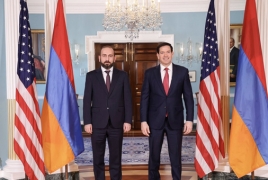 January 14, 2026 - 11:18 AMT PanARMENIAN.Net - Armenia’s Foreign Minister Ararat Mirzoyan and U.S. Secretary of State Marco Rubio in Washington endorsed a document on Armenia‑U.S. joint work under the Trump Route for International Peace and Prosperity (TRIPP) initiative. It was noted that the document, published below, represents a new step toward implementing commitments made at the White House on August 8, 2025, to contribute to lasting peace in the South Caucasus, the Ministry of Foreign Affairs said. The framework outlines concrete steps for launching TRIPP, intended to establish seamless multimodal transit connectivity through Armenian territory, linking Azerbaijan with its Nakhichevan Autonomous Republic and creating a vital link in the Trans‑Caspian trade route. It is expected that TRIPP will generate mutual international and domestic connectivity benefits for Armenia. Reflecting principles affirmed at the historic Peace Summit hosted by President Trump on August 8, the TRIPP implementation framework emphasizes the importance of sovereignty, territorial integrity, and reciprocity for the initiative’s overall success. TRIPP’s ultimate objective is to reinforce prosperity and security for Armenia and Azerbaijan, promote American trade by expanding regional commerce and connectivity, and create new transit opportunities connecting Central Asia and the Caspian to Europe. The published document describing TRIPP’s implementation outlines the launch procedure of the Trump Route for International Peace and Prosperity. This framework does not create, nor is it intended to create, legal obligations or binding commitments for Armenia or the United States. “On August 8 in Washington, in the presence of the U.S. President, the Prime Minister of Armenia and the President of Azerbaijan signed a Declaration that forms the basis for opening transport connections. The presented document clarifies the initiative’s structural and operational provisions while reinforcing the objectives of the signed declaration.” TRIPP aims to form a multilayered transit corridor through Armenia, strengthening regional stability and cooperation based on international law. It is expected to become a source of reciprocal economic opportunities for Armenia, connecting regional economic hubs. Through TRIPP, the United States seeks to:
Through TRIPP, Armenia seeks to:
Expected benefits of TRIPP for the United States include:
Expected benefits of TRIPP for Armenia and its people include:
Commitment to success Armenia’s commitment: Armenia is committed to the success of TRIPP as a strategic initiative serving its national interests. Armenia intends to take the following actions:
Prerequisites for success Armenia and the United States recognize that TRIPP’s success depends on:
Strategic partnership TRIPP reflects a deepening of Armenia‑U.S. strategic partnership. Armenia views the project as a foundation for long‑term cooperation in infrastructure, economic development, and regional integration. Establishment of TRIPP development company TRIPP is to be implemented within the transit routes planned through Armenia, at locations to be specified in the future, while preserving Armenia’s full sovereignty over the initiative’s coverage within Armenian sovereign territory. The TRIPP development company, with a U.S. controlling share and Armenian oversight on key issues, aims to ensure development and implementation of TRIPP infrastructure. Armenia intends to authorize and support the establishment of the TRIPP development company. The company is expected to be responsible for developing TRIPP, with a 49‑year initial term of the granted construction rights. Armenia intends to offer the United States a 74% share in the TRIPP development company and retain 26%. It is expected that this cooperation will extend another 50 years, granting the Armenian government additional ownership, bringing its share to 49%. Changes in shareholders of the TRIPP development company (including sales, donations, mergers, demergers, reorganizations or any other legal or de facto actions) and changes in ultimate beneficial owners will require prior agreement with the Armenian and U.S. governments. Armenia and the United States plan to work together in forming the corporate structure of the TRIPP development company. The structure is expected to reflect: (1) involvement of Armenian and U.S. governments in certain special decisions and matters concerning operation of the multimodal transit route, and (2) financial return to the United States for its initial investment, or other economic benefits to the U.S. government or U.S. companies. Decisions on certain sensitive issues within defined principle areas will be made jointly through an Armenia‑U.S. leadership committee. The TRIPP development company is expected to directly implement TRIPP rail and road projects and have subsidiaries or special purpose entities for other TRIPP components. Armenia’s share in the TRIPP development company reflects its contribution through:
Each country will appoint a senior official as the principal coordinator for TRIPP implementation, responsible for interagency coordination and serving as the main liaison with the TRIPP development company. Granting of development rights Armenia intends to grant the TRIPP development company exclusive rights to:
Development rights may include but are not limited to:
The TRIPP development company may collect and retain income from various sources including but not limited to:
Armenia clearly retains:
Special purpose entities The TRIPP development company, while directly implementing the rail and road components, is expected to establish separate legal entities for large infrastructure components as determined by further studies and analysis. Each entity will have management, financing, and operation models appropriate to the specific infrastructure type and strategic considerations. Special purpose entities will initially be established by the TRIPP development company, with understanding that private sector investment opportunities may be pursued in later phases on a case‑by‑case basis. Border security and customs control Fundamental principles: Armenia’s sovereignty and authority over border and customs operations are absolute and non‑negotiable. All border and customs activities are expected to be conducted in accordance with internationally recognized border management standards, preserving the principles of the August 8 declaration and using a “front office‑back office” operational model. Integrated border management: Armenia intends to further develop and implement modern integrated border management practices, with potential U.S. technical assistance including:
Pilot projects: Armenia intends to implement pilot projects to optimize:
“Front office‑back office” operational model: To enhance efficiency while preserving Armenian sovereignty and authority, a “front office‑back office” model using digital tools to facilitate seamless connectivity will be applied. “Front office” (third‑party operators): It is anticipated that private operators under contract with the TRIPP development company will provide customer‑facing services including:
“Back office” (Armenian state bodies): Armenian customs and border officials will exercise all sovereign authorities under Armenian law and international agreements, including:
Clear authorities: Front office operators support but do not decide. Armenian officials maintain physical presence at all border and customs facilities, and no sovereign functions are delegated. Customs procedures: Armenia will continue to develop and implement:
Security operations: Armenia retains full authority within its sovereign territory. Infrastructure security projects must be approved by Armenian security agencies. Armenian authorities have priority in all emergencies. Private operational security personnel may be employed if licensed by Armenia, the document states.   Top stories Top stories Grigoryan added that the situation around the world and particularly in the region is very difficult. The Armenian Defense Ministry has denied Azerbaijan's accusations of violating the ceasefire. Armenian Prime Minister Nikol Pashinyan took to social media to thank his Lithuanian counterpart for the contribution. President of the Armenian parliament Alen Simonyan met with the Speaker of the Azerbaijani Milli Majlis Sahiba Gafarova.   Partner news |  Latest news Latest news Viva sees growing demand for cloud services Viva sees growing demand for cloud services  In recent years, medical institutions are starting to make use of Viva’s cloud servicesTurkey replacing term "Central Asia" with "Turkestan" in textbooks The Turkish Ministry of Education is replacing the term "Central Asia" with "Turkestan" in textbooks.Armenian, German presidents meet in Berlin Armenian and German Presidents Vahagn Khachaturyan and Frank-Walter Steinmeier met in Berlin.Armenia assumes presidency of Mediterranean Network of Regulatory Authorities The Commission on Television and Radio of Armenia said it expects productive cooperation in various formats. In recent years, medical institutions are starting to make use of Viva’s cloud servicesTurkey replacing term "Central Asia" with "Turkestan" in textbooks The Turkish Ministry of Education is replacing the term "Central Asia" with "Turkestan" in textbooks.Armenian, German presidents meet in Berlin Armenian and German Presidents Vahagn Khachaturyan and Frank-Walter Steinmeier met in Berlin.Armenia assumes presidency of Mediterranean Network of Regulatory Authorities The Commission on Television and Radio of Armenia said it expects productive cooperation in various formats. |