

  False quake warning targets Armenia AI project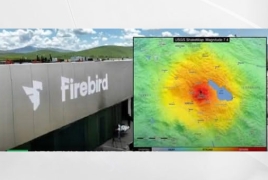 June 25, 2026 - 19:03 AMT PanARMENIAN.Net - Since June 24, a video has been circulating on X claiming that Armenia's Territorial Seismic Protection Service issued a warning about a possible magnitude 7.4 earthquake that could strike Kotayk Province in the coming weeks, where the Firebird AI data center is under construction, Factor.am reports. In reality, Armenia's Territorial Seismic Protection Service under the Ministry of Internal Affairs issued no such warning. The agency's director, Sos Margaryan, denied the claim. "Of course, we have not issued such reports and could not do so. This is another piece of disinformation. Our service conducts 24-hour monitoring, and I do not believe there is any reason for concern," Margaryan said. The video on X was shared by the Truth_Teller account, which has more than 166,000 followers. According to the report, the account has repeatedly participated in disinformation campaigns targeting Armenia. Previous false claims included allegations that Prime Minister Nikol Pashinyan planned to cancel Armenian Genocide remembrance events and that Armenia's National Security Service and Central Election Commission had created a secret software system, codenamed "Zanaves," to manipulate election results in real time during the June 7 elections. The report says earlier campaigns followed a coordinated pattern: fabricated claims first appeared on small or little-known accounts before being amplified through larger accounts on X, Telegram, and Facebook. This pattern, it adds, resembles the tactics attributed to the "Matryoshka" influence network, which has been associated with Russian hybrid influence operations. The circulating video was generated using artificial intelligence and displays the logo of the U.S. technology publication TechCrunch to make the claims appear credible. However, the original source was a spoofed website imitating TechCrunch rather than the authentic publication. The report notes that the fake domain, tech-crunch.org , copied TechCrunch's navigation menu, with links pointing to the real techcrunch.com , while the fabricated article itself was hosted only on the imitation domain. It describes this as a "Doppelgänger" technique, in which fake websites resembling well-known media outlets are used to lend credibility to false information. Based on these methods, the report suggests the operation may have been linked to the Russian hybrid influence group Storm-1516, which has previously been associated with fabricated investigations, alleged leaks from state institutions, cloned media websites, and coordinated disinformation networks. The fake article claimed that seismic risks threatened the construction timetable of a $5 billion NVIDIA-powered AI data center in Armenia. Publicly available information confirms that the Armenian government, NVIDIA, AI cloud infrastructure company Firebird, and the Team Group are cooperating on a major investment to build an advanced artificial intelligence facility in Kotayk Province. The fabricated article further claimed that an analysis by Armenia's seismic service questioned the suitability of the project because of earthquake risks and alleged that the assessment had been confirmed by the U.S. Geological Survey (USGS), predicting a magnitude 7.4 earthquake within 35 days. According to the report, no such analysis was ever conducted or published by Armenia's seismic authorities, meaning the USGS could not have confirmed it. It also notes that precise earthquake prediction is not considered scientifically reliable, and seismic agencies have repeatedly rejected similar false forecasts. The article linked the general fact that Armenia is located in a seismically active region to the Firebird project, creating the impression that the AI facility faced imminent danger. However, it provided no genuine earthquake forecast, no engineering assessment of the project's seismic resilience, and no evidence that construction could not proceed on schedule. The report argues that the campaign specifically targeted one of Armenia's largest recent technology investments, warning that attempts to create uncertainty around such projects could damage the country's investment reputation. To reinforce the false narrative, the article also included a manipulated video purporting to show Armenian engineer and seismic specialist Armen Der Kiureghian saying: "Given the recent increase in seismic activity, I strongly doubt that the first phase of the Firebird data center in Armenia will be commissioned on schedule on July 5." Der Kiureghian is an internationally recognized Armenian engineer and expert in seismic engineering, structural reliability, and risk analysis. According to the report, the video was fabricated, no authentic version has been found, and the voice was generated using artificial intelligence. Both the fake article and the AI-generated video mixed genuine facts—such as the construction of an AI facility in Kotayk Province, Armenia's location in a seismically active region, and references to the 1988 Spitak earthquake—with fabricated claims. The accompanying images used in the video were real but taken from unrelated events. The report concludes that the claims made in both the X video and the accompanying article are false. Armenia's Territorial Seismic Protection Service never issued a warning about a possible magnitude 7.4 earthquake in Kotayk Province, and the article was published not on the real TechCrunch website but on the imitation domain tech-crunch.org .   Top stories Top stories As a result of floods in Armenia’s northern Lori and Tavush provinces, 17 bridges, including five large ones, have collapsed. David Vardanyan is the son of former Karabakh leader Ruben Vardanyan who who is currently imprisoned in Azerbaijan. Prime Minister Nikol Pashinyan has met with Stephan Schütz, Executive Partner at Gerkan, Marg and Partners. The number of state universities will be reduced from 23 to 8 by 2030, Minister of Education, Science, Culture and Sport Zhanna Andreasyan has said.   Partner news |  Latest news Latest news Viva sees growing demand for cloud services Viva sees growing demand for cloud services  In recent years, medical institutions are starting to make use of Viva’s cloud servicesTurkey replacing term "Central Asia" with "Turkestan" in textbooks The Turkish Ministry of Education is replacing the term "Central Asia" with "Turkestan" in textbooks.Armenian, German presidents meet in Berlin Armenian and German Presidents Vahagn Khachaturyan and Frank-Walter Steinmeier met in Berlin.Balance of attached cards in the Idram&IDBank app From now on, users will be able to view the online balances of cards issued by ArCa system banks and attached to the app. In recent years, medical institutions are starting to make use of Viva’s cloud servicesTurkey replacing term "Central Asia" with "Turkestan" in textbooks The Turkish Ministry of Education is replacing the term "Central Asia" with "Turkestan" in textbooks.Armenian, German presidents meet in Berlin Armenian and German Presidents Vahagn Khachaturyan and Frank-Walter Steinmeier met in Berlin.Balance of attached cards in the Idram&IDBank app From now on, users will be able to view the online balances of cards issued by ArCa system banks and attached to the app. |