

  New appeals prepared concerning Armenians held in Baku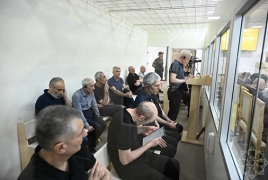 July 27, 2026 - 15:20 AMT PanARMENIAN.Net - There are currently no opportunities to obtain objective information about the health of Armenian prisoners held in Baku. Siranush Sahakyan, who represents the interests of Armenian prisoners before the European Court of Human Rights (ECHR), said this when addressing reports that some prisoners have serious injuries, including fractures, which may have resulted from violence, Sputnik Armenia reports. Sahakyan said applications are being prepared on the issue but did not consider it appropriate to disclose when or to which bodies they would be submitted. One of the main problems remains the lack of objective information about the health and detention conditions of Armenian prisoners held in Baku. Until September 2025, information was obtained through the International Committee of the Red Cross (ICRC), but that option ceased to exist after Azerbaijan ended the ICRC’s activities in the country. “We are talking about their complete isolation from the outside world, where there is no physical contact with international independent monitoring missions, independent lawyers, independent doctors or consular officials. Under these circumstances, their conditions can only be observed and information about them collected from Azerbaijani sources, which are unreliable and, most importantly, unverifiable. In other words, whatever picture is presented cannot be verified by independent, objective and impartial actors because access to the Armenian hostages is restricted,” Sahakyan said. At present, the only remaining source of information is conversations with relatives, which are also monitored by the Azerbaijani side. The frequency of telephone calls is not consistent either. According to Sahakyan, a certain discriminatory approach can be observed: one prisoner, for example, may be allowed to call relatives once a week, while another may be permitted to do so once every four or six weeks. “Moreover, this has varied throughout the period of captivity. For example, there have been cases when, during the initial period, families were unable to speak with their relative for weeks or months, or the interruptions coincided with various events or holidays there, and once again the regular frequency of calls was not maintained,” Sahakyan said. Azerbaijan is required to submit a report to the ECHR by August 31 on the detention conditions and health of Armenian prisoners, including medical documents. According to the human rights advocate, there is no guarantee that Azerbaijan will provide accurate and unaltered information. The information received must be compared with data collected by human rights advocates and information obtained from relatives. “This is the formal fulfillment of the state’s obligation, but how conscientious and complete that fulfillment is becomes a matter for subsequent consideration. If we see incomplete information or data that do not correspond to reality, we inform the court, and the court will draw the appropriate conclusions during its examination of the case,” Sahakyan said. Addressing the possible resumption of ICRC activities in Azerbaijan, Sahakyan assessed the likelihood as low. In her view, it may be more realistic to secure permission for one-time visits through agreements, although no tangible results have been achieved in that direction either. According to the human rights advocate, even if such visits prove impossible, the international community should seek alternatives. These could include arranging a visit by an independent medical team or reaching an agreement with a third country that could conduct consular visits on Armenia’s behalf. She noted that there are neutral countries, such as Switzerland, that are prepared to undertake such a humanitarian mission and organize visits on Armenia’s behalf. However, this would not be possible until an appropriate agreement is reached between the two states. Sahakyan said she found it difficult to assess how proactive Armenia has been in this process. Sahakyan stressed that even if all possible mechanisms are activated, the consent of the Azerbaijani authorities will still be necessary. “If such consent is not given, it will later be much more difficult for them to refute allegations of torture,” the human rights advocate added. Applications by relatives of Armenian prisoners to travel to Baku and visit them have also produced no tangible results so far. The request has been addressed to the Azerbaijani authorities, the Republic of Armenia, as well as foreign organizations and states that could assist with the humanitarian mission. No information about official responses has been published so far. According to official data, 19 Armenian prisoners are being held in Azerbaijan. The “trial” of the former military and political leaders of Nagorno-Karabakh, which began in Baku in January 2025, ended on February 5 this year, after which the verdicts were announced. Former Nagorno-Karabakh President Arayik Harutyunyan, former parliament speaker Davit Ishkhanyan, former Defense Army commander Levon Mnatsakanyan and former deputy Defense Army commander Davit Manukyan were sentenced to life imprisonment. Former Nagorno-Karabakh presidents Arkadi Ghukasyan and Bako Sahakyan were sentenced to 20 years in prison. Civilian prisoners Madat Babayan and Melkiset Pashayan were sentenced to 19 years in prison, Garik Martirosyan to 18 years, Davit Alahverdyan and Levon Balayan to 16 years, and Erik Ghazaryan, Gurgen Stepanyan and Vasily Beglaryan to 15 years. The “case” of former Nagorno-Karabakh State Minister Ruben Vardanyan was heard in separate proceedings. On February 17, it was reported that a Baku court had sentenced Ruben Vardanyan to 20 years in prison. On April 28, it was also reported that he had been transferred with the other Armenian prisoners to the Umbaki prison complex in Baku’s Garadagh district.   Top stories Top stories Grigoryan added that the situation around the world and particularly in the region is very difficult. The Armenian Defense Ministry has denied Azerbaijan's accusations of violating the ceasefire. Armenian Prime Minister Nikol Pashinyan took to social media to thank his Lithuanian counterpart for the contribution. President of the Armenian parliament Alen Simonyan met with the Speaker of the Azerbaijani Milli Majlis Sahiba Gafarova.   Partner news |  Latest news Latest news Viva sees growing demand for cloud services Viva sees growing demand for cloud services  In recent years, medical institutions are starting to make use of Viva’s cloud servicesTurkey replacing term "Central Asia" with "Turkestan" in textbooks The Turkish Ministry of Education is replacing the term "Central Asia" with "Turkestan" in textbooks.Armenian, German presidents meet in Berlin Armenian and German Presidents Vahagn Khachaturyan and Frank-Walter Steinmeier met in Berlin.Armenia assumes presidency of Mediterranean Network of Regulatory Authorities The Commission on Television and Radio of Armenia said it expects productive cooperation in various formats. In recent years, medical institutions are starting to make use of Viva’s cloud servicesTurkey replacing term "Central Asia" with "Turkestan" in textbooks The Turkish Ministry of Education is replacing the term "Central Asia" with "Turkestan" in textbooks.Armenian, German presidents meet in Berlin Armenian and German Presidents Vahagn Khachaturyan and Frank-Walter Steinmeier met in Berlin.Armenia assumes presidency of Mediterranean Network of Regulatory Authorities The Commission on Television and Radio of Armenia said it expects productive cooperation in various formats. |