


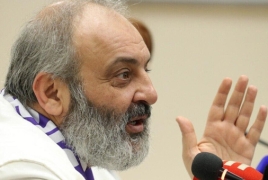


Armenia’s Prosecutor General’s Office has filed a lawsuit with the Anti-Corruption Court against Archbishop Bagrat Galstanyan, demanding the return to the state of a special-purpose land plot and buildings in Navur village, in the Berd community of Tavush province.
According to the prosecutor’s statement, a criminal investigation established that 1,198.09 square meters of real estate and 6.0536 hectares of special-purpose land, which had been granted to the Ministry of Defense for free use, were sold on July 24, 2014, for 8,717,184 drams.
Later, on July 17, 2017, the same property — including a barracks and other buildings — was transferred to Archbishop Galstanyan for 400,000 drams.
The Prosecutor’s Office stated that the land had special-purpose status at the time of the transaction and still retains it, and under Armenian law such land cannot be transferred into private ownership. According to the legal justification, buildings located on such land also cannot be privatized and may only be provided under usage or development rights.
Based on these grounds, on March 16, 2026, the Prosecutor’s Office filed a lawsuit seeking the return of the land and its structures to state ownership, including the barracks, dining facility, warehouse, residential and auxiliary buildings.
In 2023, the Prosecutor’s Office had already filed a lawsuit seeking to invalidate the 2014 sale agreement, but the Anti-Corruption Court rejected the claim, citing the expiration of the statute of limitations. That ruling has been appealed to the Court of Appeal.
Lawyer Tatevik Soghoyan, representing Galstanyan, said the land in Navur village had been transferred to the archbishop years earlier from a third party. With support from friends and through loans, a farm and meat production facility were later established there to create jobs for the local community.
According to her, the project was halted due to the COVID-19 pandemic and the 2020 war, while the loan obligations remain with Archbishop Galstanyan.
“Back in 2023, the Prosecutor’s Office applied to the court seeking to invalidate the transaction through which the land had initially been transferred from the state to a third party in 2014 and to return the property to the state.
Archbishop Bagrat, as a good-faith purchaser, and the company Tavush Eco Meat, which had invested in the project, were involved in the case as third parties.
During the trial, the prosecutor repeatedly refused to provide evidence regarding the statute of limitations issue — at times submitting incorrect documents or claiming such evidence did not exist. Only after the court’s demand were the necessary documents presented.
In December 2025, the Anti-Corruption Court rejected the claim due to the expiration of the statute of limitations. The decision has not entered into legal force, as it has been appealed. However, realizing that the case had little prospect — given the many procedural mistakes by the prosecution — the prosecutor did not wait for the appellate decision and instead filed a new lawsuit pursuing the same goal: to deprive Archbishop Bagrat of the property,” Sogoyan said.
She added that Archbishop Galstanyan himself has not yet been informed about the new lawsuit, but the defense sees no reason to conceal the situation.
Soghoyan also stated that in the history of independent Armenia the land has never been used as a military barracks or a military facility.
According to her, the “special-purpose” designation dates back to the Soviet period, when anti-hail stations were located in the area.