


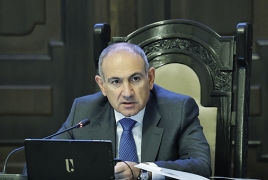


Prime Minister Nikol Pashinyan, presenting the Civil Contract party’s election program, highlighted the policy of regionalization and stressed the importance of further developing the “3+3” format, noting that Armenia will contribute to its deepening.
He added that Russia’s involvement in the format also makes it important for the constructive transformation of Armenia–Russia relations.
Pashinyan said regionalization aims to make living within Armenia’s immediate environment without external support not only possible but comfortable, emphasizing the need to further develop relations with Georgia, Iran, Turkey, and Azerbaijan, Armenpress reports.
In this context, the full unblocking of regional transport infrastructure, including the implementation of the TRIPP project and the launch of the Gyumri–Kars railway, will strengthen peace and cooperation while turning the region into a key hub of East–West and North–South connectivity — Crossroads of Peace.
“Armenia has also adopted the ‘Regionalization-2’ concept, referring to Central Asia, the Middle East, and India. Alongside developing relations with other countries, establishing diplomatic ties with Saudi Arabia and Pakistan was also significant. This direction will gain new momentum in 2026–2031,” he said.
He noted that some opposition figures in Armenia frequently accuse the authorities, and him personally, of being pro-Azerbaijani or pro-Turkish.
“What has actually happened? In reality, for years we communicated with Azerbaijan and Turkey through third countries, discussing more than 90 percent of our agenda that way. And what did we observe? A simple fact: when you communicate through a third party, you cannot be sure your messages are conveyed accurately, nor that their responses are transmitted precisely, because intermediaries may have their own interests and perceptions.
This has been one of the reasons why peace was not established in our region for many years. We changed our approach and said: if we have things to discuss with Turkey and Azerbaijan — and we clearly do — why not speak directly? This is the only guarantee that our message is delivered correctly and that we receive an accurate response.
…This shift in our approach is what some use to accuse us of being pro-Turkish or pro-Azerbaijani. For decades, our practice was to rely on others to convey messages. We have chosen, and will continue to choose, direct communication, while not excluding the involvement of third countries where necessary. There are agendas where such involvement is essential, but in bilateral relations, communication must remain active. It is thanks to this understanding that we now have peace,” the prime minister said.
Parliamentary elections in Armenia are scheduled for June 7, 2026.