


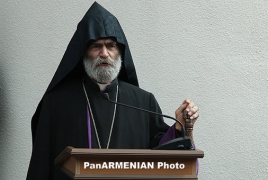


Archbishop Pargev Martirosyan has sent an official appeal to the U.S. president, members of the Senate and Congress, the Pope of Rome, and leaders of influential international and church organizations, raising concerns over the destruction of Armenian spiritual and cultural heritage in Artsakh.
The appeal stresses that the issue concerns not only Armenian values but also sites of pan-Christian and universal significance, including churches, khachkars, and other sacred monuments.
Martirosyan called on international actors to provide a clear assessment of the situation, ensure access for UNESCO and other organizations to the affected territories, and establish effective monitoring mechanisms. He also urged the use of all possible means to prevent the final destruction of still-preserved sanctuaries.
According to the appeal, the destruction of Armenian Christian heritage, including churches, cemeteries and monuments, continues in territories now under Azerbaijani control. It highlights particularly alarming reports that two churches in Stepanakert—the Holy Hakob Church and the main cathedral of the Holy Mother of God—have recently been completely demolished, describing this as a systematic and deliberate eradication of Armenian cultural and spiritual presence.
The statement emphasizes that the issue is not political rhetoric but one of protecting sacred sites, defending historical truth, and preserving a heritage that belongs to all Christian civilization.
It recalls that on December 7, 2021, the International Court of Justice obliged Azerbaijan to take measures to prevent and punish acts of vandalism against Armenian cultural heritage. It also cites a March 10, 2022 resolution by the European Parliament condemning the destruction of Armenian heritage in Nagorno-Karabakh and calling for UNESCO access.
However, UNESCO noted in a December 21, 2025 statement that it was still awaiting Azerbaijan’s response to deploy a mission, meaning a full independent assessment has yet to be carried out.
The appeal also refers to findings by the Caucasus Heritage Watch monitoring program, which reported that since 2021, 14 heritage sites have been destroyed, 14 damaged, and 30 remain at risk. Documented cases include the destruction of the St. John the Baptist Church (Kanach Zham) in Shushi and the complete demolition of the Ghazanchetsots cemetery.
Martirosyan stressed that these are not merely architectural losses but sacred places embodying centuries of faith and identity, warning that their destruction damages spiritual memory and historical continuity.
He called on international leaders to:
- Provide clear moral and legal assessments of ongoing destruction
- Support immediate and unrestricted access for UNESCO
- Help establish a permanent international monitoring mechanism
- Use all political, diplomatic and ecclesiastical tools to protect heritage
- Take urgent measures to save the remaining sites from destruction
The archbishop concluded by urging the international community to move beyond statements and take concrete action, warning that silence in such circumstances is especially troubling and calling for a firm and responsible voice in defense of endangered sacred heritage.