


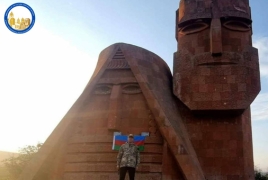


Artsakh’s cultural heritage ombudsman has warned that the iconic “We Are Our Mountains” monument may face complete destruction amid rising threats and vandalism.
Hovik Avanesov, vice president of the National historical and cultural NGO, said in a Facebook post that the symbol of Artsakh — We Are Our Mountains monument — is under threat of total destruction.
According to him, Azerbaijani official and unofficial platforms are actively circulating statements calling for the monument’s complete demolition.
He recalled that following the large-scale military operations launched against Artsakh on September 19, 2023, and the subsequent takeover of the territory and forced displacement of Armenians, Azerbaijani forces placed their flag on the monument on September 29, the day Stepanakert was captured, demonstratively violating its historical and cultural significance.
In November 2024, photos and videos circulated on social media documented new acts of vandalism: both the front and back parts of the monument were damaged, and anti-Armenian and offensive inscriptions appeared. The surrounding area was also affected. At the same time, Azerbaijani platforms have continued spreading calls for its complete destruction.
Avanesov noted that a similar scenario had already been applied to Saint Hakob Church and the Holy Mother of God Cathedral, where destruction was preceded by comparable propaganda campaigns. This, he said, raises serious concern that the monument could face the same fate.
He stressed that the monument’s history goes beyond cultural achievement. Even during Soviet times, it faced political resistance amid open opposition from the leadership of Soviet Azerbaijan.
Despite those pressures, the monument was erected, becoming not only a work of art but also a symbol of resistance.
The “We Are Our Mountains” monument, also known as “Grandma and Grandpa” (Tatik-Papik), is one of the most symbolic representations of Armenian identity, historical memory and cultural heritage. It was created in 1967 by sculptor Sargis Baghdasaryan and architect Yuri Hakobyan. Made of red tuff and about 9 meters tall, it stands atop a hill, symbolizing the inseparable bond between the people of Artsakh and their land.
The sculpture depicts an elderly Artsakh couple in traditional attire, standing shoulder to shoulder with a proud and steadfast posture. It has no pedestal, appearing to emerge directly from the ground, embodying deep roots and an unbreakable connection to the homeland. The work has also received international recognition, having been presented at a prestigious exhibition in Carrara, Italy, and acknowledged as a global cultural value.
Earlier, it was reported that Azerbaijan had demolished the Holy Mother of God Cathedral in Stepanakert. Prior to that, Saint Hakob Church in the city had also been destroyed. The Artsakh Union issued a statement calling on Armenia’s authorities to “reconsider inaction that encourages Baku,” describing the destruction of Armenian churches in Stepanakert as manifestations of cultural genocide.