


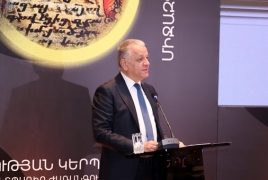


A laboratory for studying and restoring Arabic-script manuscripts has opened at Matenadaran.
The 15th jubilee international seminar, titled “Forms of Memory: Latest Technologies for Preserving and Restoring Manuscript and Printed Heritage,” has begun at Matenadaran with support from the Ministry of Education, Science, Culture and Sports and the EU Delegation in Armenia.
Head of the EU Delegation Vassilis Maragos emphasized the importance of joint work in preserving cultural heritage.
“The European Union is proud to support Armenia in preserving its rich cultural heritage. It is a great honor to be Matenadaran’s partner in this important work. We are pleased to join this initiative to focus international efforts on preserving manuscript and printed heritage,” he said.
Minister of Education, Science, Culture and Sports Zhanna Andreasyan said the seminar has developed into a growing platform, bringing together more than 140 institutions from around 40 countries.
“Key institutions working to preserve written heritage have in one way or another engaged with or participated in the seminar. This proves that the seminar has become a platform where we hold the most important discussions on preserving and restoring written heritage,” she said.
According to her, the seminar’s agenda is multilayered, enabling specialists to discuss problems and find solutions. Andreasyan stressed the importance of preserving written heritage, viewing it not only as a means of transmitting memory but also of recognizing and reinterpreting it.
“We need to know the stories related to our written heritage more deeply and comprehensively. The development of modern technologies provides new opportunities to ensure the study and accessibility of written heritage in the digital environment, making it part of public memory,” she emphasized, noting that Matenadaran has become an important international platform.
Ara Khzmalyan said 145 international institutions are participating in the seminar, including restoration centers, libraries, museums and archives.
“The seminar’s thematic scope is also broad, ranging from the physical and biochemical issues of written heritage to digitization, laser restoration and the use of high technologies. All this can be summarized in one idea: shared responsibility for international written heritage. We must realize that memory is not only the physical presence of writing, but also the human biography behind it. Manuscripts are the fingerprints of history, and in Matenadaran’s manuscripts, those traces have tangible specificity,” he said.
As part of the event, Zhanna Andreasyan awarded a ministry medal to Tamara Ohanyan, a specialist at the U.S. Library of Congress, for her long-standing participation in the seminar.
In addition, a cancellation ceremony was held for the “Armenian Miniature Art” postage stamp, and the Matenadaran laboratory for studying and restoring Arabic-script manuscripts was opened.