


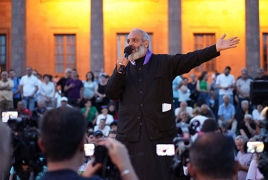


The United Nations has published official correspondence between the Armenian government and six UN Special Rapporteurs and mandate holders concerning the case of Archbishop Bagrat Galstanyan and his supporters in the Sacred Struggle movement.
The experts asked Armenia to answer eight key questions concerning the alleged excessive use of force by police, arrests, the factual and legal grounds for the criminal charges, whether the accusations against Sacred Struggle members meet the definition of terrorism, and whether administrative restrictions imposed on the movement's members comply with international law, Factor.am reported.
According to the document sent to the Armenian government on May 11, the experts sought clarification regarding information they had received about the alleged disproportionate use of force, the possible misuse of counterterrorism and national security charges, and administrative restrictions imposed on members and supporters of the Sacred Struggle movement since May 2025. They expressed concern that, based on the information received, these measures might not comply with Armenia's international human rights obligations.
The document states that peaceful demonstrations held between April and June 2024 were reportedly accompanied by arbitrary arrests and police violence, including the alleged use of flashbang devices, resulting in injuries to at least 83 protesters and eight journalists on June 12, 2024.
It also notes that protesters sought to secure the prime minister's resignation through a parliamentary vote of no confidence, but the initiative was unsuccessful. Although the peaceful protests later subsided, the Sacred Struggle movement continued its political activities.
The document further states that in June 2025, Armenia's prime minister and the Investigative Committee announced that they possessed evidence alleging that the movement and Archbishop Bagrat Galstanyan had planned to seize power unconstitutionally through terrorism.
According to the experts, measures taken against Sacred Struggle since May 2025 could form part of a broader policy aimed at suppressing dissent against opposition groups, public figures, political parties and the Armenian Apostolic Church. The document says the reported pattern includes the possible abuse of law enforcement powers, politically motivated prosecutions, the application of counterterrorism legislation and coordinated campaigns to stigmatize critics. It also refers to the authorities' criticism of the Armenian Apostolic Church's involvement in political affairs.
The authors of the letter stated that, if confirmed, the allegations could be inconsistent with Armenia's international human rights obligations.
Armenia's Permanent Mission to the United Nations Office and other international organizations in Geneva submitted an official 31-page response.
The response states that Armenia remains firmly committed to ensuring that all criminal investigations are conducted in strict compliance with the rule of law and legal requirements. According to the government, every procedural action under national legislation is intended to protect the fundamental rights guaranteed by Armenia's Constitution and ensure a fair trial for all participants.
The response also says that several of the experts' questions are based on allegations that have not yet been established and remain under examination in ongoing investigations and judicial proceedings conducted in accordance with due process.
"By incorporating international best practices into our operational framework, we have strengthened the transparency, predictability and integrity of the investigative process. The response also states that the criminal charges do not concern the defendants' political, religious or ideological views, nor their participation in peaceful assemblies, public debate or lawful political activity. The criminal proceedings were initiated solely on the basis of evidence allegedly indicating preparations for violent criminal offenses against the constitutional order," the document says.